
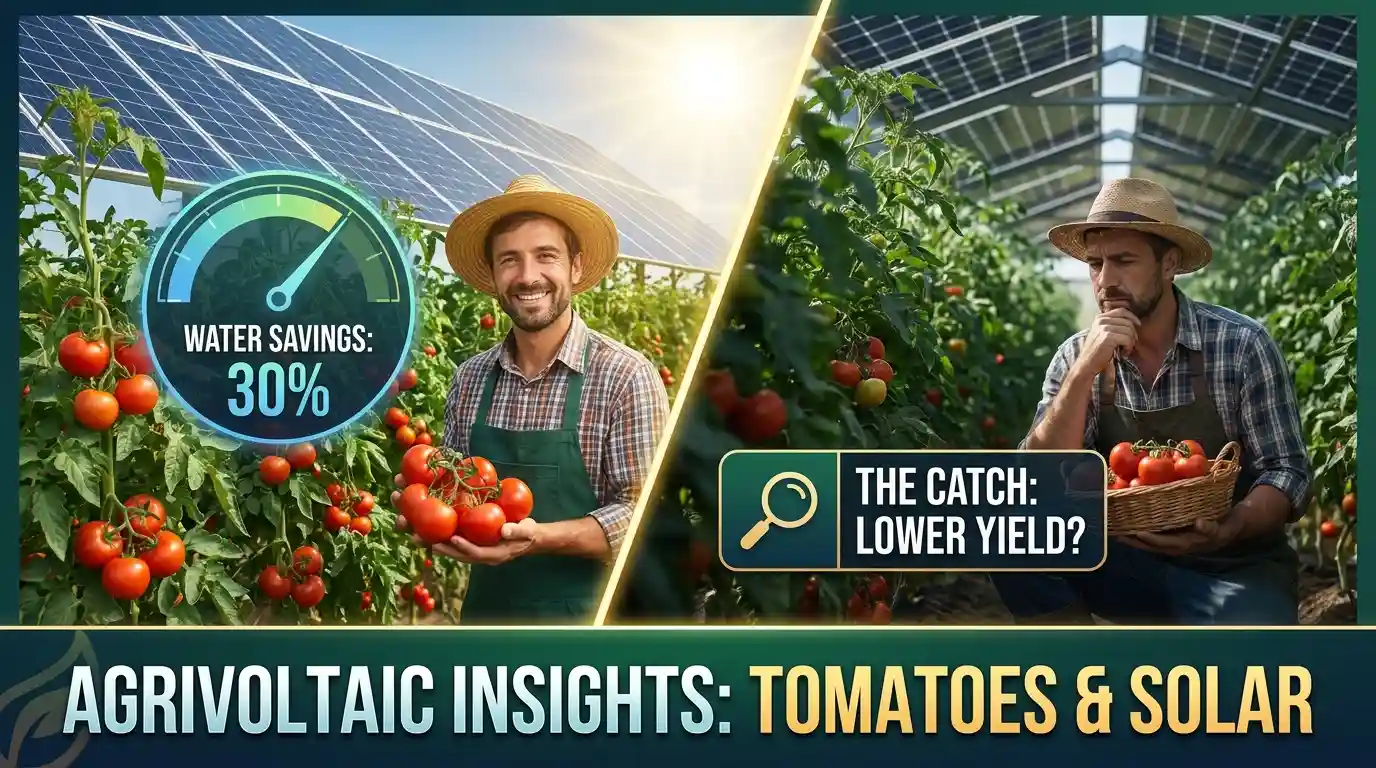
Tomatoes Under Solar Panels
Used 30% less water. Same juicy harvest. Here’s the catch nobody mentions.
Your tomato plants are drowning in sun they don’t need.
Full blast, 8+ hours a day, every single day. You assumed more sun equals more tomatoes. Wrong.
A Spanish research team just proved it. University of Seville. Polytechnic University of Madrid. Two years of field trials. And the result flips everything you think you know about growing tomatoes.
1. What actually happened
Researchers planted tomatoes under solar panels. Elevated ones, six feet up. Not buried in shade – dappled light, like standing under a loose umbrella.
Same tomatoes, same soil, no panels, full sun. That was the control group.
The panel group used 30% less water. And still produced a solid, sellable harvest – findings that were later confirmed in the full peer-reviewed study published by the research team.
★ Remember. Shade from solar panels doesn’t starve tomatoes of light. It stops them from wasting water they never needed in the first place.
2. Why less sun didn’t mean less fruit
Here’s the part that surprised even the researchers.
✦ Old assumption: Tomatoes need max sun exposure, all day, to ripen properly.
✦ What the data showed: Partial shade lowered leaf temperature. Lower temperature meant less water lost to evaporation. Less water lost meant the plant spent less energy just surviving – and more energy making fruit.
Think of it like running a marathon in 60°F versus 95°F. Same distance. Wildly different amount of water you need to survive it.
If your plants have ever looked fine in the morning and collapsed by afternoon, that’s the same mechanism at play – something we broke down when we covered reviving heat-stressed tomato plants.
✓ Tip. If your tomatoes wilt hard by 2pm every afternoon, that’s not thirst. That’s heat stress. Shade cloth does almost the same job as a solar panel – for free.
3. Here’s the catch
This is where most headlines stop. Don’t stop here.
The 30% water savings only held at moderate shade. Not heavy shade. Not directly under the panel where sun barely reaches.
Israeli researchers ran a separate trial on processing tomatoes and found the line where it breaks:
- Moderate shade → yield dropped 10–20%. Water savings held. Fine trade.
- Heavy shade (directly under panel) → yield dropped 40–55%. Not fine. Not close.
⚠ Warning. “Under solar panels” is not one setup. It’s a spectrum. Get the angle wrong and you don’t save water – you just grow fewer tomatoes for no reason.
4. What this means for your backyard
You don’t need actual solar panels to use this. That’s the real unlock here.
- Use 30–40% shade cloth, not 70%+. Full block kills yield.
- Position it high – 5 to 6 feet above the plant, not draped directly on leaves.
- Leave gaps for direct morning sun. The danger window is midday to 3pm.
- Water less, not more, once shade is up. Your plant needs it less now – the same logic behind why we tell people to stop watering tomatoes at night in the first place.
- Check soil moisture before assuming it’s dry. It probably isn’t.
That’s it. No panels required.
5. Where full sun still wins
Being honest here, because the internet won’t be.
- If you’re in a naturally cool or cloudy climate (Pacific Northwest, UK, hill regions), shade will hurt you, not help. Tomatoes there are already fighting for enough light.
- Commercial growers chasing max yield per acre still lean full sun. The water savings don’t outweigh the yield hit at scale – unless water costs more than the lost fruit. In drought regions, it flips.
- Container tomatoes on a balcony with already-limited light shouldn’t be shaded further. You’ll just get leggy, fruitless plants.
Shade is a tool for hot climates with water stress. Not a universal upgrade.
Where to start
- Check tomorrow’s forecast. Above 90°F (32°C) for 3+ days straight? That’s your shade-cloth trigger.
- Buy 30% shade cloth – cheap, one-time cost.
- Rig it 5–6 feet up, angled so morning sun still hits the plant.
- Cut your watering by a third and watch the soil, not the calendar.
- Compare fruit count at season end versus last year. That’s your real data, not mine.
Your tomatoes were never asking for more sun. They were asking for less stress.
PS: If this saved you from over-watering a plant that didn’t need it, send it to the one friend who still waters their garden on a strict daily schedule.