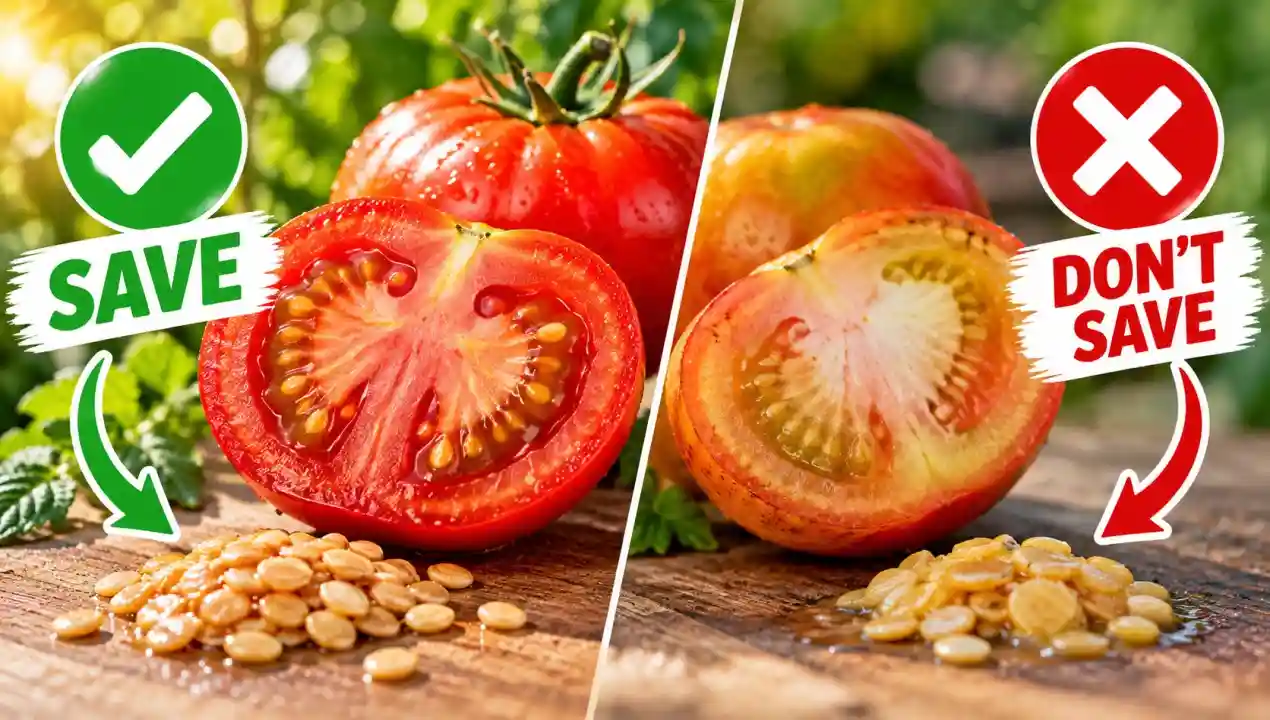
Most gardeners save tomato seeds wrong.
Not because they don’t care. Because they skip five checks that take less than two minutes total. And then they wonder why next year’s plants look nothing like what they grew.
Here’s what to verify before you drop a single seed into a paper envelope.
1. Is the Tomato a Hybrid or Open-Pollinated?
This is the one thing that kills most seed-saving attempts before they start.
Hybrid tomatoes — labeled F1 on seed packets — are bred by crossing two parent varieties. The fruit you eat is generation one. Save seeds from it, plant them next year, and you’re in generation two. That’s when things go wrong. You’ll get unpredictable plants. Some weak. Some unproductive. Almost none like the tomato you saved from.
Open-pollinated varieties are different. They breed true. Save seeds from a Brandywine, grow it next season, and you get a Brandywine. That’s the whole point.
Check your original seed packet. Look for “F1” anywhere on the label. If you see it — stop. Don’t bother saving those seeds.
No packet? Look up the variety name. Takes 30 seconds. If you want the full walkthrough on going from saved seed all the way to a growing plant, our guide on planting tomato seeds from tomatoes covers every step.
2. Was the Tomato Healthy?
Don’t save seeds from a sick plant. Obvious, but people do it all the time.
Some tomato diseases — early blight, septoria leaf spot, certain bacterial issues — are cosmetic. The plant looks rough but the fruit is fine. Seeds from those plants are probably okay.
But serious disease problems are a different story. If your plant had mosaic virus, fusarium wilt, or collapsed halfway through the season for no clear reason — do not save from it. Some pathogens hitch a ride on seeds. You plant next year, and you’re starting the season already infected.
The rule is simple. Unhealthy parent, risky seeds.
Pick from a plant that looked good all season. Green leaves, strong stem, no early collapse.
3. Was This One of Your Best Plants?
Here’s where most gardeners leave value on the table.
They walk into the garden, grab the first ripe tomato they see, and save seeds from it. Random selection. No thought behind it.
That’s the old way.
The better approach: deliberately pick from your best performer. The plant that fruited earliest. The one that kept producing when others slowed down. The one with the fewest pest problems. The one with the biggest, densest clusters.
You’re not just saving seeds. You’re making a selection decision that compounds over years.
Save from the best plant this season, grow it again next season, save again from the best plant — after a few cycles, you’ve slowly adapted that variety to your specific soil and climate.
Gardeners did this for thousands of years before F1 hybrids existed. According to The Old Farmer’s Almanac, home-saved seeds often germinate better and faster than store-bought ones – likely because they’re fresher and handled more carefully.
That’s it.
4. Could the Variety Have Cross-Pollinated?
Tomatoes are mostly self-pollinating. The flower pollinates itself before insects can usually interfere. That’s why they’re a relatively safe crop for seed saving.
Relatively.
Cross-pollination still happens — especially if you’re growing multiple varieties close together, if you have a lot of bumblebees working the garden, or if you’re growing potato-leaf varieties (which have more exposed stigmas and cross more readily).
If your San Marzano was planted three feet from your Cherokee Purple, and a bumblebee was busy all summer — there’s a small but real chance your saved seeds are a cross. The fruit you ate looked right. But the genetics inside those seeds might be a surprise.
The honest answer: one generation of cross-pollination usually still gives you a recognizable plant. But it might not be identical. And if you keep saving from crosses, it drifts further each year.
Solution: grow varieties with at least 10 feet of separation, or cage one plant with a lightweight mesh during flowering if variety purity matters to you.
5. Is the Fruit Fully Mature?
This one gets skipped because people think “ripe enough to eat” means “ready to save seeds from.”
It doesn’t.
Seed maturity lags behind fruit ripeness. A tomato that’s perfect for eating — red, soft, ready to slice — has seeds that are still finishing their development. The embryo inside is viable, but just barely.
For the best germination rates, you want a tomato that’s slightly past peak eating stage. Deeper color. Maybe a little soft. Still firm enough to hold shape. On the vine longer than you’d normally leave it.
Some seed savers deliberately leave a marked fruit on the plant until it starts to wrinkle at the blossom end. That’s when you know the seed inside is fully mature.
Pull it too early and your germination rate suffers. Wait a bit longer than feels right.
It’s worth it.
Once you’ve saved and dried your seeds, our guide on how to grow tomatoes from a tomato walks through exactly how to get them germinating well the following season.
What Happens If You Save Seeds From a Hybrid Tomato?
You’ll get plants. They’ll germinate fine. They might even look great early in the season.
Then things get strange.
F2 generation plants — what you get when you grow saved hybrid seeds — show genetic splitting. Some traits from one parent line. Some from the other. Some unexpected combinations of both. You might get tomatoes that are smaller, different colored, lower yielding, or have different disease resistance than the original.
This isn’t always bad. Some gardeners actually do this intentionally. It’s called F2 selection — growing out hybrid seeds, then selecting the best plants, and stabilizing them over several generations. It’s how new open-pollinated varieties are born.
But if you just wanted to replicate what you grew last year? Saving hybrid seeds won’t get you there. You’d need to buy the same F1 packet again.
That’s the catch with hybrids.
The Tomato Seed-Saving Checklist
Before you save, run through this:
✅ Check 1 — Variety type
Is it open-pollinated or heirloom? Not F1? Good. Proceed.
✅ Check 2 — Plant health
Did the mother plant stay healthy all season? No serious disease? Good.
✅ Check 3 — Plant performance
Was this one of your strongest, most productive plants? Choosing deliberately? Good.
✅ Check 4 — Cross-pollination risk
Were varieties well-separated? Or were you careful about isolation? Good.
✅ Check 5 — Fruit maturity
Is the fruit fully ripe — or slightly past peak? Not just eating-ripe? Good.
All five checked?
Save those seeds. Label the envelope with variety name, harvest date, and which plant it came from. Store in a cool, dry, dark place.
Done right, tomato seeds stay viable for 4–6 years.
That’s one afternoon of work buying you half a decade of free seeds.


