Introduction: The High Risk, High Reward Game
Let’s get real. Growing tomatoes in summer is easy. Everyone does it, the market gets crowded, and prices drop to ₹5 per kg. You hardly make any profit.
But tomato farming during the rainy season? That is where the real money is made.
In July and August, heavy rains can ruin 80% of open-field tomato crops. Fields become waterlogged, fungal diseases can destroy acres overnight, and the supply chain falls apart. At this time, prices can soar to ₹80, ₹100, or even ₹150 per kg.
If you can keep your crop healthy while others are drowning in mud, you’re not just farming, you’re making a fortune.
But humidity is a challenge. The warm, wet air is perfect for problems like Early Blight, Late Blight, and Bacterial Wilt. You can’t farm like usual. You need a strong plan.
This guide isn’t about wishing for the best, it’s about having a clear strategy. I’ll show you the steps and fungicide schedules I use to grow top-quality tomatoes, even in heavy rain.
Land Preparation: The First Line of Defense
If you plant tomatoes on flat ground during the rainy season, you’re likely to fail. Even the best seeds can’t survive if their roots sit in water for over 24 hours. The plants will turn yellow, wilt, and eventually die.
The key to growing tomatoes in the rain is good drainage. You need to lift the root zone.
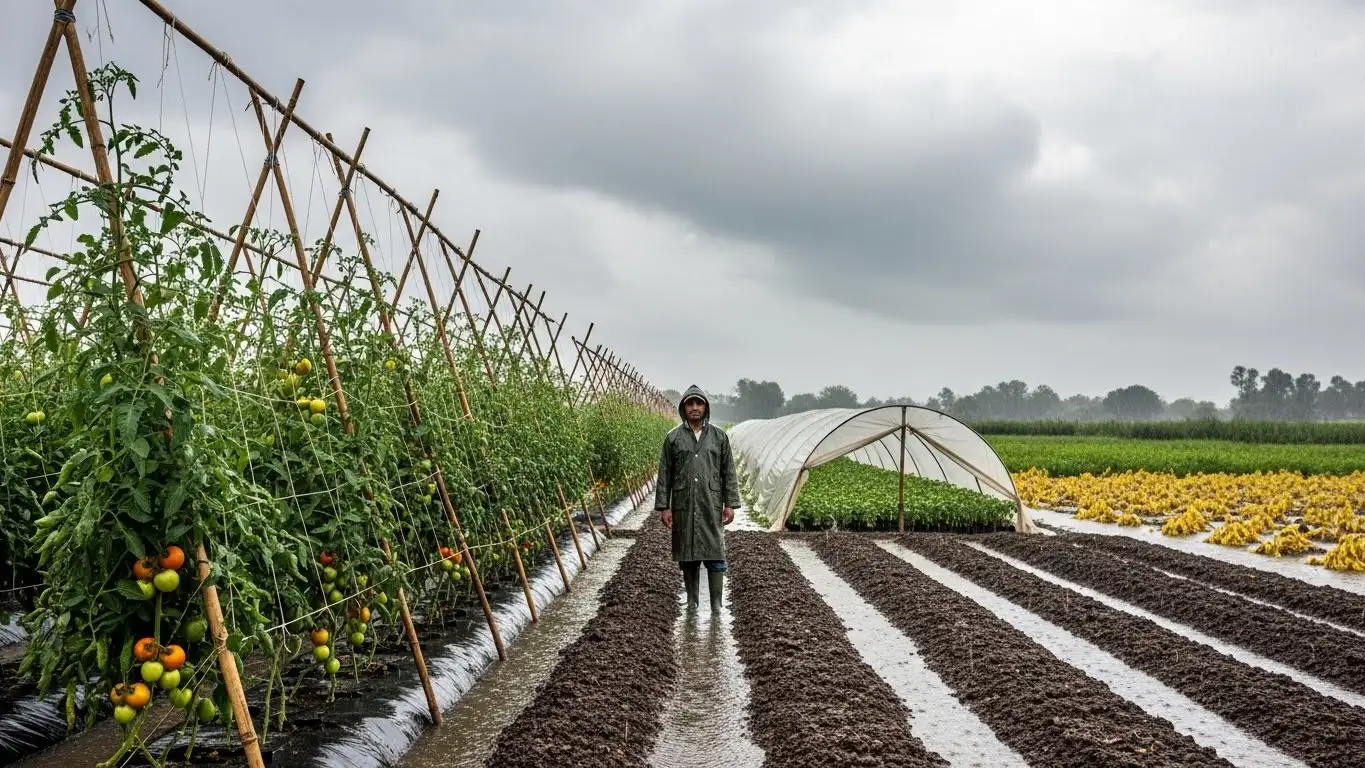
Make raised beds that are 1 to 1.5 feet high. This helps excess water drain quickly away from the roots during heavy rain.
Bed Dimensions:
- Height: 1.5 feet (important for drainage).
- Width: 1 meter (top surface).
- Pathways: Leave 1.5 feet between beds for walking and spraying fungicides without packing the soil.
Prepare the Soil
The soil can have dormant germs that wake up with moisture. It’s important to treat it before planting any seeds.
- Lime (Chuna): Add agricultural lime when plowing to balance the pH. Fungi thrive in acidic soil, and lime makes it harder for them.
- Trichoderma viride: This is a helpful fungus. Mix 2 kg of Trichoderma with 100 kg of farmyard manure and spread it on the beds. It helps control harmful fungi that cause wilt.
Selecting the Right Variety (Don’t Skip This)
Avoid standard summer varieties. They have thin skins and weak defenses. If you plant a generic “desi” variety during the rain, the fruit will crack as it swells, and the leaves will turn black with disease in just a week.
Instead, go for Indeterminate (Tall) varieties. They grow upright, allowing you to support them with trellises. This keeps them off the ground and helps air circulate, drying the leaves quickly after rain.
Best Hybrids for Rainy Season in India/Tropics:
- Arka Meghali: Developed for rainy conditions, this variety handles wet weather well.
- Arka Abhed (F1): Tough against diseases, it has genes that fight Tomato Leaf Curl Virus and Bacterial Wilt.
- Heemshikar: Known for its thick skin, this variety doesn’t crack even in soggy soil.
- Abhinav / US-440: Strong growth that endures heavy wind and rain.
Managing Your Nursery in Wet Weather
The problems start even before you reach the field. The biggest threat to seedlings in the rain is Damping Off.
You might notice a healthy seedling suddenly has a black stem at the base and falls over. This fungal issue occurs due to high humidity.
Nursery Best Practices:
- Use a Plastic Tunnel: Never grow rainy season nurseries outside. A simple plastic tunnel keeps the rain off the trays.
- Choose Coco-Peat: Avoid garden soil; use clean coco-peat instead.
- Drench as Protection: At the two-leaf stage, soak the trays with Copper Oxychloride (COC) at 3g per liter of water. This coats the stem and protects against the damping-off fungus.
Structural Support: Staking and Trellising
In the rainy season, keep all leaves off the ground. Soil splash spreads blight. When raindrops hit the mud, they can splash soil filled with fungal spores onto the lower leaves, allowing the disease to spread up the plant.
Soil splash is the primary way blight infects your plant. When a raindrop hits the mud, it splashes soil particles—loaded with fungal spores—onto the lower leaves. From there, the disease climbs up the plant like a ladder.
How to Stake Your Plants:
- Single Stake: Put strong bamboo sticks next to each plant and tie the main stem to it.
- Overhead Trellis: For tall varieties, run a wire about 6 feet above the bed and use twine to guide the plants upwards.
The 6-Inch Rule (Pruning)
Once the plant is stable, trim all leaves and branches from the bottom 6 to 9 inches of the stem. This creates an “air gap” between wet soil and the leaves. This simple step can cut blight infection by 50% and allows wind to dry out the sticky mud faster.
Disease Management Schedule (The Most Important Section)
Don’t wait for black spots on your leaves. If you do, you’ll lose 30% of your crop. During the rainy season, spray your tomatoes to prevent problems.
Fungal spores are everywhere. While you can’t stop them, you can protect your plants with a spray that kills them on contact.
Stick to this schedule. Don’t skip a week just because your plants look fine.
| Growth Stage | Days After Planting (DAP) | Disease Risk | Recommended Action / Chemical | Mechanism |
| Vegetative | 10–20 Days | Early Blight, Leaf Spot | Mancozeb (M-45) @ 2.5g/L + Neem Oil | Contact: Creates a protective layer on the leaf surface. |
| Branching | 25–35 Days | Bacterial Spot, Canker | Copper Oxychloride (COC) @ 3g/L + Streptocycline (0.5g/L) | Bactericide: Copper fights bacteria that spread in water. |
| Pre-Flowering | 40–45 Days | Late Blight (Rapid spread) | Metalaxyl + Mancozeb (Ridomil Gold) @ 2g/L | Systemic: Enters the plant system to fight infection from inside. |
| Fruiting | 55–65 Days | Fruit Rot, Anthracnose | Azoxystrobin (Amistar) @ 1ml/L | Broad Spectrum: Protects the developing fruit skin from rotting. |
| Harvesting | Every 10 Days | General Protection | Alternating Mancozeb and COC | Maintain the protective shield. |
Important Note: Always add a “Sticker” or “Spreader” (silicon-based) to your spray tank. Without it, rain can wash away your costly treatment.
Harvesting Strategy: The “Breaker” Stage
Avoid Waiting for Red Tomatoes
Many beginners make a mistake by waiting for tomatoes to turn deep red before picking them. During the rainy season, too much water causes the tomatoes to swell.
If left on the vine until they are red and soft, they may crack. Once they crack, pests can lay eggs in them, and mold can develop.
Pick at the Breaker Stage
Instead, harvest tomatoes when they change to a yellowish-orange color, known as the Breaker Stage. This means the fruit is mature but not too watery.
What to Do Next?
Take the tomatoes indoors to a cool, dry room. In about three days, they’ll ripen into shiny red tomatoes. They will be firm, uncracked, and more valuable in the market since they last longer.
FAQ: Common Rainy Season Questions
Which fertilizer is best for tomatoes in the rainy season?
Avoid high Nitrogen (Urea). Excess nitrogen can lead to rapid, weak growth and even cause Nitrogen Burn. It also attracts pests. Instead, use Potash (K) and Calcium. Potash helps strengthen the plant against disease, while Calcium prevents issues like Blossom End Rot.
How to control fruit cracking?
To prevent cracking, in addition to early harvest, use a foliar spray of Boron (1g/L) and Calcium Nitrate during the fruit-setting stage. This will help the tomato skin stay elastic and stretchy.
Can I grow organic tomatoes in the monsoon?
Growing organic tomatoes during the monsoon is challenging. Organic fungicides like Pseudomonas and Sour Buttermilk work best in dry weather, but wash away in heavy rain.
For commercial growers, use Integrated Pest Management (IPM). Apply biological methods on sunny days and use chemicals only when necessary during heavy rains.
Keep a guide on tomato pests handy so you can quickly identify and manage any insect issues during dry spells.
Conclusion
Tomato farming in the rainy season takes hard work. You need to check your plants every day, carefully spray them, and set up the right structures.
Here’s a tip: If you spend an extra ₹20,000 per acre on bamboo stakes, raised beds, and Metalaxyl, but sell your tomatoes at ₹100/kg instead of ₹10/kg, you’ll make a great profit.
Here are the Big 3 Tips:
- Drainage: Water standing on the ground can kill your plants. Use raised beds that are 1.5 feet high.
- Support: Use stakes to keep leaves off the ground.
- Prevention: Spray fungicides before you see any problems.
The rain is coming, and the market is ready. Start preparing your raised beds now!


