Watering a tomato plant in the ground is easy. Watering one in a 5-gallon bucket is a high-stakes game.
In a bucket, you don’t have the safety net of the earth. If you miss a watering on a hot day, your plant fries. If you water too much, the roots drown in “soup” and rot. This constant swing between “too wet” and “too dry” is the #1 reason bucket tomatoes fail.
You need a system. You need the “Sponge Method.”
The Golden Rule: Weight = Water
Most guides tell you to “stick your finger in the soil.” That works for houseplants, but it’s bad advice for a 6-foot tomato vine. The top inch might be dry, but the bottom could be swampy.
The Pro Trick: Lift the bucket.
- Heavy Bucket: It has water. Walk away.
- Light Bucket: It’s thirsty. Water immediately.
After a week, you will develop “muscle memory” for exactly how much your plant drinks.
How Often Should I Water?
There is no schedule (like “every Monday”). You must water based on the temperature:
- Below 70°F (Spring): Every 2–3 days.
- 70°F – 85°F (Early Summer): Once a day (Mornings are best).
- Above 90°F (Heat Wave): Twice a day (Morning AND late afternoon).
Warning: If your plant is wilting at 2 PM on a hot day, check the soil before watering. Sometimes plants wilt just to protect themselves from the sun, even if the roots are wet. If the soil is damp, DO NOT water.
Overwatering leads to root rot, which damages the roots’ ability to transport water and nutrients, causing wilting even when soil is wet. Learn more about identifying and fixing overwatering symptoms in tomatoes to avoid this critical mistake.
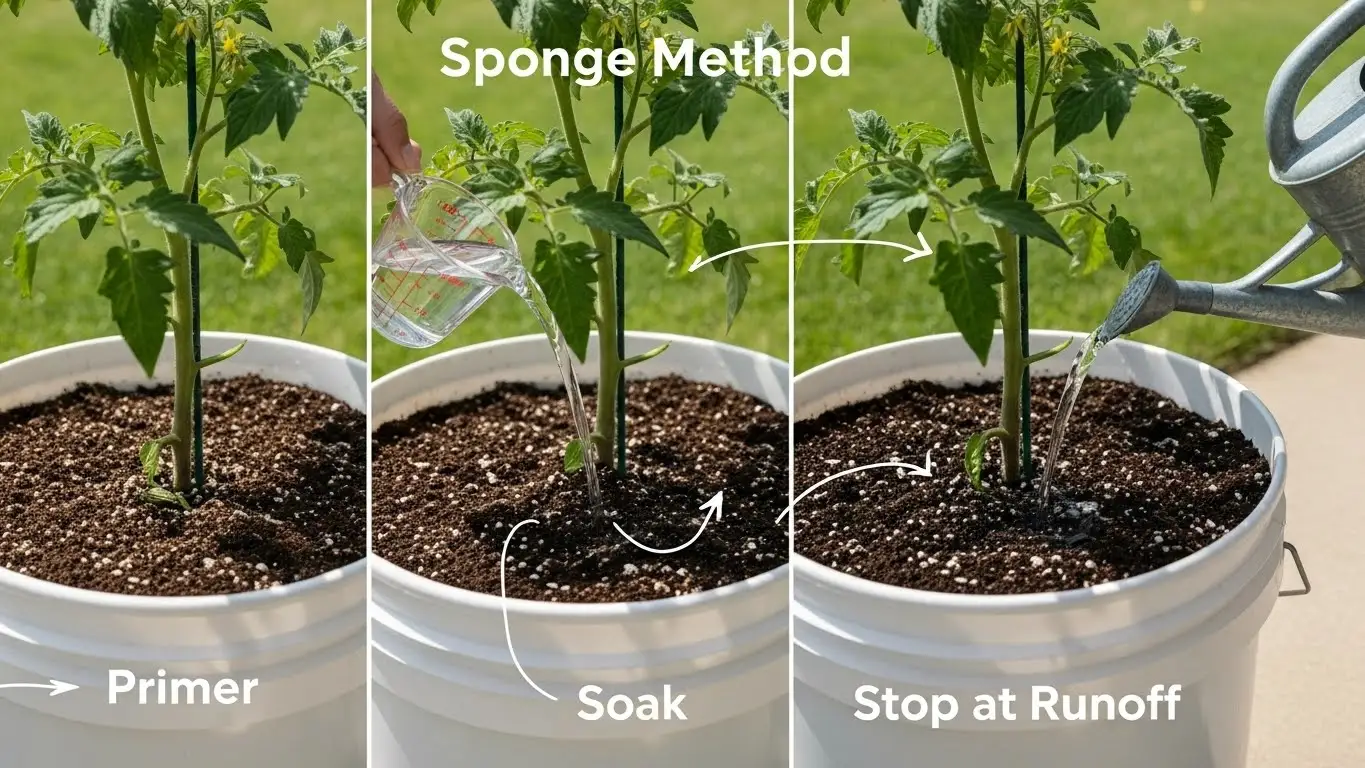
The “Sponge Method” (How to Water Correctly)
If you dump a gallon of water onto dry soil, it will often rush straight down the sides of the bucket and out the drainage holes without wetting the roots. This is called “channeling.”
The Fix:
- The Primer: Pour 1 cup of water slowly. Wait 30 seconds. This “wakes up” the peat moss and makes it absorbent.
- The Soak: Now pour the rest of the water slowly until you see water trickling out the bottom holes.
- The Stop: As soon as you see runoff, STOP. You have fully saturated the sponge.
The Secret Weapon: Why You Must Mulch Your Buckets
If you leave the soil bare in a black 5-gallon bucket, the summer sun will bake the roots and evaporate water before the plant even drinks it.
Mulch acts as a lid. It traps the moisture inside and keeps the roots cool. Without mulch, you are fighting a losing battle against the heat.
The Best Mulch for 5-Gallon Buckets:
- Straw: Cheap, effective, and reflects sunlight to keep roots cool.
- Pine Bark Fines: Great for drainage and looks cleaner.
- Shredded Cardboard: A free option that worms love.
- Grass Clippings: Use dried clippings only (wet ones can mold).
Action Step: Apply a 2-inch layer of mulch to the top of every bucket immediately. You will find yourself watering 50% less often.
The Hidden Danger: The “Nutrient Flush”
Here is the catch-22 of bucket gardening: You must water until it drains out the bottom to prevent salt buildup. But every time water leaves the bucket, it takes vital nutrients (Nitrogen and Calcium) with it.
If you water daily but only fertilize once a month, you are slowly starving your plant. This is why many bucket tomatoes turn yellow in July.
The Fix: “Weakly, Weekly” Instead of a heavy feeding once a month, switch to a micro-dose schedule.
- Use a water-soluble liquid fertilizer.
- Dilute it to 50% strength.
- Apply it once a week.
This replaces exactly what you washed away without burning the plants.
The Ultimate Upgrade: The Double Bucket System
If you can’t water twice a day, you need a Self-Watering System. You don’t need to buy one; you can make one with two buckets.
- Inner Bucket: Drill holes in the bottom. Fill with soil and plant.
- Outer Bucket: No holes. This holds the water reservoir.
- The Wick: Stuff an old cotton t-shirt strip into one of the holes of the inner bucket so it dangles into the water below. It will suck water up like a straw as the plant needs it.
For more container growing strategies and self-watering solutions that work on patios and small spaces, check out our complete guide on backyard patio tomato ideas, which covers container selection and automated watering systems for bucket-grown tomatoes.
Conclusion
Water is the delivery truck for your nutrients. If the soil is too dry, the truck stops. If it’s too wet, the truck crashes.
By using the “Lift Test” and the “Sponge Method,” you ensure that your fertilizer actually reaches the plant to create those massive, juicy tomatoes you’ve been working for.
However, proper watering is only half the battle—learn how to avoid nitrogen burn and balance your fertilizer, so your bucket tomatoes get the nutrition they need without toxicity.


